Polyatomic Ions
The common polyatomic ions with their formulas and charges, grouped by charge, and how their names work.
A polyatomic ion is a group of atoms bonded together that carries an overall charge, such as nitrate (NO₃⁻) or ammonium (NH₄⁺). They behave as a single unit in ionic compounds and stay together in solution. Unlike simple ions, their charges can't be read from the periodic table, so most chemistry courses ask you to learn the common ones. The list below groups them by charge.
Cations (3)
| Name | Formula | Charge |
|---|---|---|
| Ammonium | NH₄⁺ | 1+ |
| Hydronium | H₃O⁺ | 1+ |
| Mercury(I) | Hg₂²⁺ | 2+ |
1− Anions (23)
| Name | Formula | Charge |
|---|---|---|
| Acetate | CH₃COO⁻ | 1− |
| Amide | NH₂⁻ | 1− |
| Azide | N₃⁻ | 1− |
| Bromate | BrO₃⁻ | 1− |
| Chlorate | ClO₃⁻ | 1− |
| Chlorite | ClO₂⁻ | 1− |
| Cyanate | OCN⁻ | 1− |
| Cyanide | CN⁻ | 1− |
| Dihydrogen phosphate | H₂PO₄⁻ | 1− |
| Formate | HCOO⁻ | 1− |
| Hydrogen carbonate (bicarbonate) | HCO₃⁻ | 1− |
| Hydrogen sulfate (bisulfate) | HSO₄⁻ | 1− |
| Hydrogen sulfite | HSO₃⁻ | 1− |
| Hydroxide | OH⁻ | 1− |
| Hypochlorite | ClO⁻ | 1− |
| Iodate | IO₃⁻ | 1− |
| Nitrate | NO₃⁻ | 1− |
| Nitrite | NO₂⁻ | 1− |
| Perbromate | BrO₄⁻ | 1− |
| Perchlorate | ClO₄⁻ | 1− |
| Periodate | IO₄⁻ | 1− |
| Permanganate | MnO₄⁻ | 1− |
| Thiocyanate | SCN⁻ | 1− |
2− Anions (10)
| Name | Formula | Charge |
|---|---|---|
| Carbonate | CO₃²⁻ | 2− |
| Chromate | CrO₄²⁻ | 2− |
| Dichromate | Cr₂O₇²⁻ | 2− |
| Hydrogen phosphate | HPO₄²⁻ | 2− |
| Oxalate | C₂O₄²⁻ | 2− |
| Peroxide | O₂²⁻ | 2− |
| Silicate | SiO₃²⁻ | 2− |
| Sulfate | SO₄²⁻ | 2− |
| Sulfite | SO₃²⁻ | 2− |
| Thiosulfate | S₂O₃²⁻ | 2− |
3− Anions (5)
| Name | Formula | Charge |
|---|---|---|
| Arsenate | AsO₄³⁻ | 3− |
| Borate | BO₃³⁻ | 3− |
| Citrate | C₆H₅O₇³⁻ | 3− |
| Phosphate | PO₄³⁻ | 3− |
| Phosphite | PO₃³⁻ | 3− |
Shaded rows are -ate / -ite pairs: the -ite ion has one oxygen atom fewer than the -ate ion, with the same charge.
Print this chart
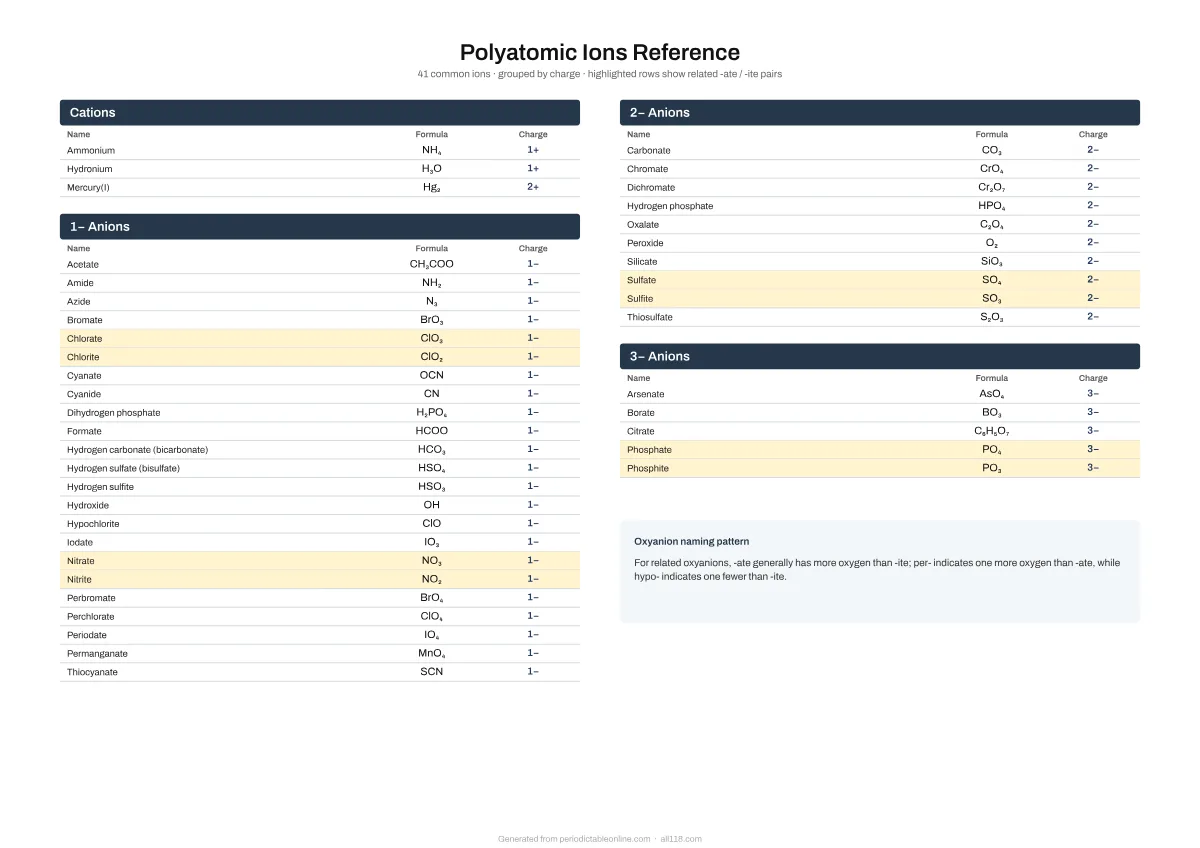
Common polyatomic ions used in high-school and introductory chemistry, alphabetised within charge groups. Related -ate and -ite pairs are highlighted so the naming pattern is easy to learn.
All printable periodic table PDFs · Interactive periodic table
Advertisement
How polyatomic ion names work
Most polyatomic anions contain oxygen, and their endings tell you how much:
- -ate is the common form: nitrate NO₃⁻, sulfate SO₄²⁻, phosphate PO₄³⁻.
- -ite has one oxygen fewer, with the same charge: nitrite NO₂⁻, sulfite SO₃²⁻.
- per-…-ate has one oxygen more than -ate: perchlorate ClO₄⁻.
- hypo-…-ite has one oxygen fewer than -ite: hypochlorite ClO⁻.
Adding a hydrogen ion lowers the charge by one: carbonate CO₃²⁻ becomes hydrogen carbonate (bicarbonate) HCO₃⁻, and phosphate PO₄³⁻ becomes hydrogen phosphate HPO₄²⁻ and then dihydrogen phosphate H₂PO₄⁻.
Writing formulas with polyatomic ions
Balance the charges so the compound is neutral, and put the polyatomic ion in brackets when you need more than one: calcium nitrate is Ca(NO₃)₂, because one Ca²⁺ needs two NO₃⁻. Ammonium sulfate is (NH₄)₂SO₄. Never change the formula inside the ion: the numbers inside belong to the ion itself. The charges of the simple ions are on our periodic table with charges.
The ones to learn first
If you only learn a few, start with ammonium (NH₄⁺), hydroxide (OH⁻), nitrate (NO₃⁻), hydrogen carbonate (HCO₃⁻), carbonate (CO₃²⁻), sulfate (SO₄²⁻) and phosphate (PO₄³⁻). They appear in most exam questions and in the solubility rules.
Frequently asked questions
What is a polyatomic ion?
A polyatomic ion is a charged particle made of two or more atoms bonded together, such as sulfate (SO₄²⁻) or ammonium (NH₄⁺). It acts as one unit in ionic compounds.
What is the difference between -ate and -ite ions?
An -ite ion has one oxygen atom fewer than the matching -ate ion, with the same charge. Nitrate is NO₃⁻ and nitrite is NO₂⁻; sulfate is SO₄²⁻ and sulfite is SO₃²⁻.
Which polyatomic ions are positive?
The common positive polyatomic ions are ammonium (NH₄⁺), hydronium (H₃O⁺) and mercury(I) (Hg₂²⁺). Almost all other common polyatomic ions are negative.
What is the charge of phosphate?
Phosphate, PO₄³⁻, has a charge of 3−. Hydrogen phosphate (HPO₄²⁻) is 2− and dihydrogen phosphate (H₂PO₄⁻) is 1−.
How do you write formulas with polyatomic ions?
Balance the total positive and negative charge, and use brackets around the polyatomic ion when you need more than one of it, as in Ca(OH)₂ or Al₂(SO₄)₃.