Periodic Table with Charges
The charge each element usually takes as an ion, with its oxidation states and a printable chart.
An ion's charge comes from how many electrons an atom gains or loses to reach a stable outer shell. For the main-group elements, the group number tells you the charge: group 1 forms 1+ ions, group 2 forms 2+, group 13 forms 3+, group 15 forms 3−, group 16 forms 2− and group 17 forms 1−. Transition metals are different: many form more than one ion, such as iron (Fe²⁺ and Fe³⁺) and copper (Cu⁺ and Cu²⁺). The table below lists the common ions of every element that forms them.
| Element | Symbol | Group | Common ions | Oxidation states |
|---|---|---|---|---|
| Hydrogen | H | 1 | H⁺, H⁻ | −1, +1 |
| Lithium | Li | 1 | Li⁺ | +1 |
| Beryllium | Be | 2 | Be²⁺ | +2 |
| Nitrogen | N | 15 | N³⁻ | −3, −2, −1, +1, +2, +3, +4, +5 |
| Oxygen | O | 16 | O²⁻ | −2, −1, +1, +2 |
| Fluorine | F | 17 | F⁻ | −1 |
| Sodium | Na | 1 | Na⁺ | +1 |
| Magnesium | Mg | 2 | Mg²⁺ | +1, +2 |
| Aluminum | Al | 13 | Al³⁺ | +1, +2, +3 |
| Phosphorus | P | 15 | P³⁻ | −3, −2, −1, +1, +2, +3, +4, +5 |
| Sulfur | S | 16 | S²⁻ | −2, −1, +1, +2, +3, +4, +5, +6 |
| Chlorine | Cl | 17 | Cl⁻ | −1, +1, +2, +3, +4, +5, +6, +7 |
| Potassium | K | 1 | K⁺ | +1 |
| Calcium | Ca | 2 | Ca²⁺ | +1, +2 |
| Scandium | Sc | 3 | Sc³⁺ | +3 |
| Titanium | Ti | 4 | Ti⁴⁺ | +2, +3, +4 |
| Chromium | Cr | 6 | Cr³⁺ | +2, +3, +6 |
| Manganese | Mn | 7 | Mn²⁺, Mn⁴⁺ | +2, +3, +4, +6, +7 |
| Iron | Fe | 8 | Fe²⁺, Fe³⁺ | −2, −1, +1, +2, +3, +4, +5, +6 |
| Cobalt | Co | 9 | Co²⁺, Co³⁺ | +2, +3 |
| Nickel | Ni | 10 | Ni²⁺ | +2, +3 |
| Copper | Cu | 11 | Cu⁺, Cu²⁺ | +1, +2 |
| Zinc | Zn | 12 | Zn²⁺ | +2 |
| Gallium | Ga | 13 | Ga³⁺ | +1, +3 |
| Arsenic | As | 15 | As³⁻ | −3, +3, +5 |
| Selenium | Se | 16 | Se²⁻ | −2, +4, +6 |
| Bromine | Br | 17 | Br⁻ | −1, +1, +3, +5, +7 |
| Rubidium | Rb | 1 | Rb⁺ | +1 |
| Strontium | Sr | 2 | Sr²⁺ | +2 |
| Yttrium | Y | 3 | Y³⁺ | +3 |
| Zirconium | Zr | 4 | Zr⁴⁺ | +4 |
| Molybdenum | Mo | 6 | Mo⁴⁺ | +2, +3, +4, +5, +6 |
| Technetium | Tc | 7 | Tc⁴⁺ | +4, +6, +7 |
| Ruthenium | Ru | 8 | Ru³⁺, Ru⁴⁺ | 0, +2, +3, +4, +6, +8 |
| Rhodium | Rh | 9 | Rh³⁺ | +1, +3, +4 |
| Palladium | Pd | 10 | Pd²⁺, Pd⁴⁺ | +2, +4 |
| Silver | Ag | 11 | Ag⁺ | +1, +2, +3 |
| Cadmium | Cd | 12 | Cd²⁺ | +2 |
| Indium | In | 13 | In³⁺ | +1, +3 |
| Tin | Sn | 14 | Sn²⁺, Sn⁴⁺ | +2, +4 |
| Antimony | Sb | 15 | Sb³⁺ | −3, +3, +5 |
| Tellurium | Te | 16 | Te²⁻ | −2, +4, +6 |
| Iodine | I | 17 | I⁻ | −1, +1, +3, +5, +7 |
| Cesium | Cs | 1 | Cs⁺ | +1 |
| Barium | Ba | 2 | Ba²⁺ | +2 |
| Lanthanum | La | 3 | La³⁺ | +3 |
| Cerium | Ce | — | Ce³⁺, Ce⁴⁺ | +3, +4 |
| Praseodymium | Pr | — | Pr³⁺ | +3, +4 |
| Neodymium | Nd | — | Nd³⁺ | +3 |
| Promethium | Pm | — | Pm³⁺ | +3 |
| Samarium | Sm | — | Sm³⁺ | +2, +3 |
| Europium | Eu | — | Eu²⁺, Eu³⁺ | +2, +3 |
| Gadolinium | Gd | — | Gd³⁺ | +3 |
| Terbium | Tb | — | Tb³⁺ | +3, +4 |
| Dysprosium | Dy | — | Dy³⁺ | +3 |
| Holmium | Ho | — | Ho³⁺ | +3 |
| Erbium | Er | — | Er³⁺ | +3 |
| Thulium | Tm | — | Tm³⁺ | +3 |
| Ytterbium | Yb | — | Yb³⁺ | +2, +3 |
| Lutetium | Lu | 3 | Lu³⁺ | +3 |
| Hafnium | Hf | 4 | Hf⁴⁺ | +2, +3, +4 |
| Tungsten | W | 6 | W⁴⁺ | +2, +3, +4, +5, +6 |
| Rhenium | Re | 7 | Re⁴⁺ | +4, +6, +7 |
| Osmium | Os | 8 | Os⁴⁺ | +2, +3, +4, +6, +8 |
| Iridium | Ir | 9 | Ir³⁺, Ir⁴⁺ | +1, +2, +3, +4, +6 |
| Platinum | Pt | 10 | Pt²⁺, Pt⁴⁺ | +2, +4, +6 |
| Gold | Au | 11 | Au⁺, Au³⁺ | +1, +3 |
| Mercury | Hg | 12 | Hg⁺, Hg²⁺ | +1, +2, +4 |
| Thallium | Tl | 13 | Tl⁺, Tl³⁺ | +1, +3 |
| Lead | Pb | 14 | Pb²⁺, Pb⁴⁺ | −2, +2, +4 |
| Bismuth | Bi | 15 | Bi³⁺ | −3, +3, +5 |
| Polonium | Po | 16 | Po²⁺, Po⁴⁺ | −2, +2, +4 |
| Astatine | At | 17 | At⁻ | −1, +1, +3, +5 |
| Francium | Fr | 1 | Fr⁺ | +1 |
| Radium | Ra | 2 | Ra²⁺ | +2 |
| Actinium | Ac | — | Ac³⁺ | +3 |
| Thorium | Th | — | Th⁴⁺ | +3, +4 |
| Uranium | U | — | U⁴⁺ | +2, +3, +4, +5, +6 |
| Plutonium | Pu | — | Pu⁴⁺ | +2, +3, +4, +5, +6, +7 |
| Americium | Am | — | Am³⁺ | +2, +3, +4 |
| Curium | Cm | — | Cm³⁺ | +3, +4 |
| Berkelium | Bk | — | Bk³⁺ | +3, +4 |
| Californium | Cf | — | Cf³⁺ | +2, +3 |
| Einsteinium | Es | — | Es³⁺ | +2, +3 |
| Fermium | Fm | — | Fm³⁺ | +2, +3 |
| Mendelevium | Md | — | Md³⁺ | +2, +3 |
| Nobelium | No | — | No²⁺, No³⁺ | +2, +3 |
| Lawrencium | Lr | 3 | Lr³⁺ | +3 |
88 elements with common ions. Common ions: Greenwood & Earnshaw, Chemistry of the Elements (2nd ed.). Oxidation states: the main states listed on each element page.
Print this chart
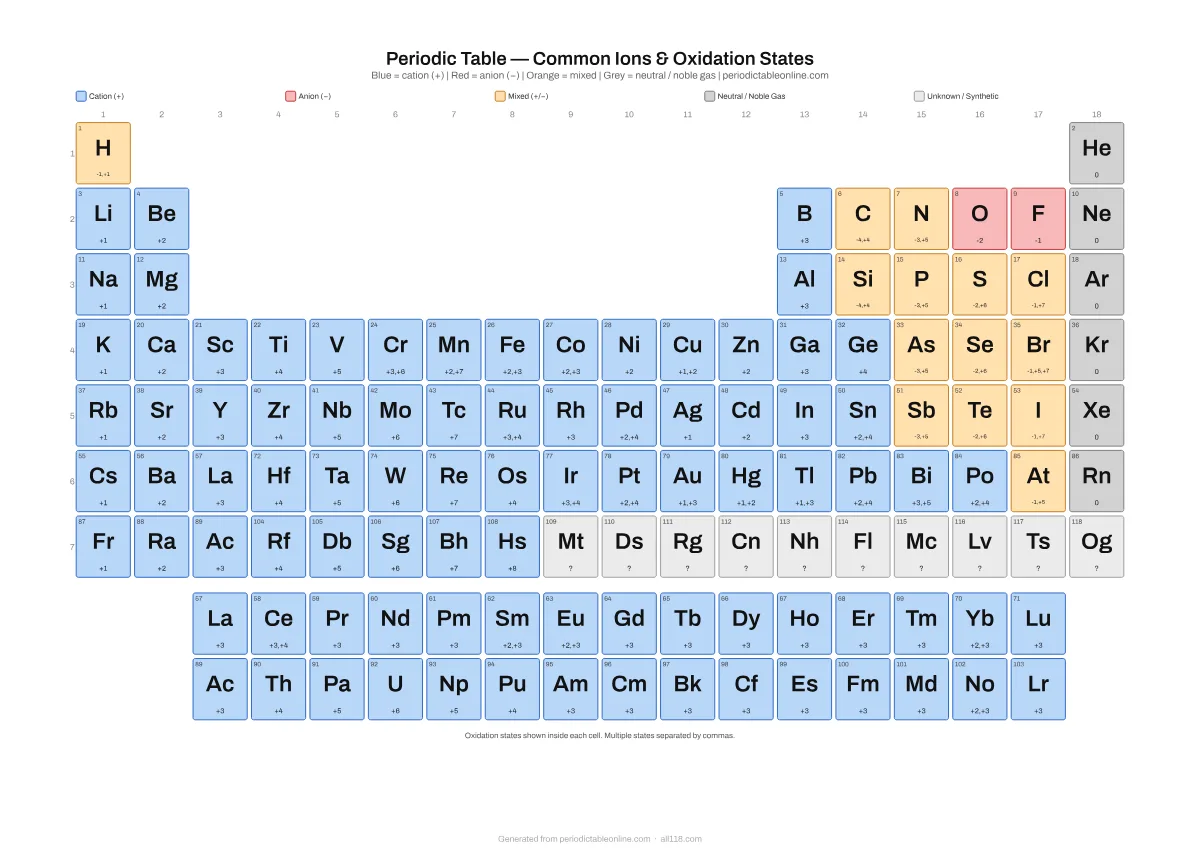
Every element cell shows its common oxidation states with the cell background colour-coded by charge type: blue for cations, red for anions, orange for elements with mixed charges (like iron or manganese), and grey for neutral noble gases. Indispensable for writing ionic equations, predicting products, and naming compounds.
All printable periodic table PDFs · Interactive periodic table
Advertisement
Charges by group
| Group | Usual charge | Example |
|---|---|---|
| 1 (alkali metals) | 1+ | Na⁺, K⁺ |
| 2 (alkaline earth metals) | 2+ | Mg²⁺, Ca²⁺ |
| 13 | 3+ | Al³⁺ |
| 14 | Varies (often shares electrons) | Sn²⁺, Pb²⁺ |
| 15 | 3− | N³⁻, P³⁻ |
| 16 | 2− | O²⁻, S²⁻ |
| 17 (halogens) | 1− | Cl⁻, Br⁻ |
| 18 (noble gases) | None: full outer shell | — |
Transition metals with more than one charge
Transition metals can lose different numbers of electrons from their d and s orbitals, so many have two or more common ions. The name of a compound shows which one with a Roman numeral: iron(II) chloride is FeCl₂ and iron(III) chloride is FeCl₃. A few have a single common charge: zinc (Zn²⁺), silver (Ag⁺) and cadmium (Cd²⁺). Our guide on how to find the charge of an ion works through examples.
Charges and oxidation states
An ion's charge is a real charge on a single ion. An oxidation state is a bookkeeping number, used even when electrons are shared. They match for simple ions, but an element can have oxidation states it never shows as a free ion: nitrogen is +5 in nitric acid but forms only the N³⁻ ion. The printable chart lists oxidation states, and the table above shows both. Ions made of several atoms, such as sulfate (SO₄²⁻), are on our polyatomic ions page.
Frequently asked questions
How do you find the charge of an ion from the periodic table?
For main-group elements, use the group: groups 1, 2 and 13 lose electrons to form 1+, 2+ and 3+ ions, and groups 15, 16 and 17 gain electrons to form 3−, 2− and 1− ions. Transition metals often have more than one charge, so learn the common ones.
What is the charge of iron?
Iron forms two common ions: Fe²⁺ (iron(II)) and Fe³⁺ (iron(III)). Fe³⁺ is more common in air, which is why rust is iron(III) oxide.
Why do noble gases have no charge?
Noble gases already have a full outer shell of electrons, so they have no tendency to gain or lose electrons and do not form ions under normal conditions.
Which transition metals have only one charge?
Zinc (Zn²⁺), silver (Ag⁺), cadmium (Cd²⁺) and scandium (Sc³⁺) usually form only one ion, so their compound names do not need a Roman numeral.
What is the difference between ion charge and oxidation state?
An ion's charge is the actual charge on a single ion. An oxidation state is the charge an atom would have if all its bonds were ionic. They are the same for simple ions, but oxidation states also apply to atoms in covalent compounds.