Solubility Rules
Which ionic compounds dissolve in water, the exceptions to each rule, and the colours of common precipitates.
Solubility rules predict whether an ionic compound dissolves in water. They are general rules, not laws: each lists the common exceptions you need for school and university chemistry. Use them to decide whether mixing two solutions will form a precipitate, an insoluble solid that settles out.
Generally soluble
| Rule | Exceptions |
|---|---|
| All Group 1 salts (Li⁺, Na⁺, K⁺, Rb⁺, Cs⁺) | No common exceptions |
| All ammonium salts (NH₄⁺) | No common exceptions |
| All nitrates (NO₃⁻) | No common exceptions |
| All acetates (CH₃COO⁻) | Ag⁺ is slightly soluble |
| All chlorates (ClO₃⁻) and perchlorates (ClO₄⁻) | No common exceptions |
| Chlorides, bromides and iodides (Cl⁻, Br⁻, I⁻) | Except Ag⁺, Pb²⁺ and Hg₂²⁺ |
| Sulfates (SO₄²⁻) | Except Ba²⁺, Pb²⁺, Sr²⁺ and Hg₂²⁺; Ca²⁺ and Ag⁺ are slightly soluble |
Generally insoluble
| Rule | Exceptions |
|---|---|
| Carbonates (CO₃²⁻) | Except Group 1 and NH₄⁺ |
| Phosphates (PO₄³⁻) | Except Group 1 and NH₄⁺ |
| Chromates (CrO₄²⁻) | Except Group 1, NH₄⁺, Ca²⁺ and Mg²⁺ |
| Sulfides (S²⁻) | Except Group 1, Group 2 and NH₄⁺ |
| Hydroxides (OH⁻) | Except Group 1, NH₄⁺ and Ba²⁺; Ca²⁺ and Sr²⁺ are slightly soluble |
| Oxides (O²⁻) | Except Group 1; Group 2 oxides react with water |
Colours of common precipitates
| Precipitate | Colour |
|---|---|
| AgCl | white |
| AgBr | cream |
| AgI | pale yellow |
| BaSO₄ | white |
| PbI₂ | bright yellow |
| Cu(OH)₂ | pale blue |
| Fe(OH)₂ | green |
| Fe(OH)₃ | red-brown |
| CaCO₃ | white |
Print this chart
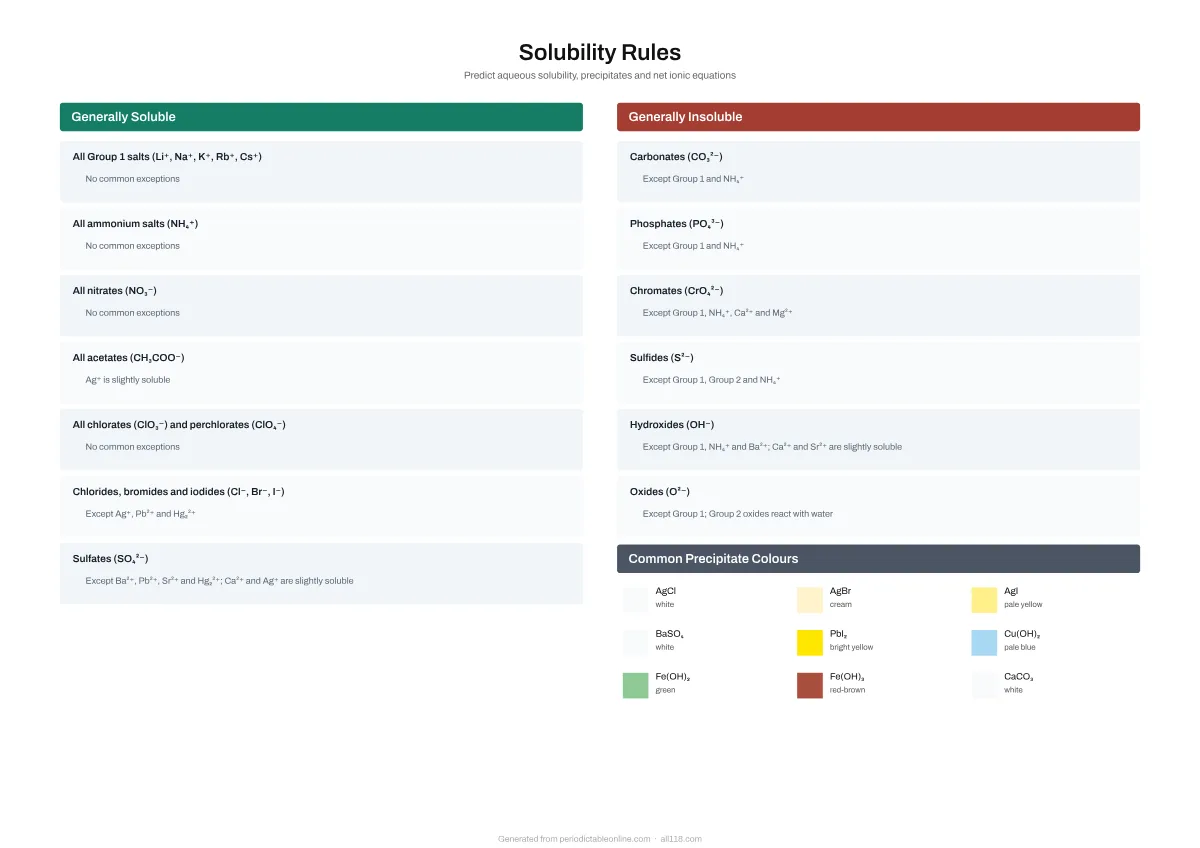
A two-column reference for generally soluble and insoluble ionic compounds, including standard exceptions and a laboratory precipitate-colour key.
All printable periodic table PDFs · Interactive periodic table
Advertisement
How to use the solubility rules
Look at both ions in the compound. If either ion is in the "generally soluble" table with no exception that applies, the compound dissolves. For example, every nitrate dissolves, so lead nitrate, Pb(NO₃)₂, is soluble. If the compound's anion is in the "generally insoluble" table and its cation isn't one of the exceptions, it doesn't dissolve: calcium carbonate, CaCO₃, is insoluble because calcium isn't in group 1.
Predicting a precipitate
When you mix two solutions, the ions can swap partners. If one of the new combinations is insoluble, it comes out as a precipitate. Mixing silver nitrate and sodium chloride gives sodium nitrate, which stays dissolved, and silver chloride, which is insoluble: a white precipitate forms. Write it as a net ionic equation with only the ions that react: Ag⁺(aq) + Cl⁻(aq) → AgCl(s).
What precipitate colours tell you
Many precipitates have a distinctive colour, which is how lab tests identify ions. The silver halides are white (AgCl), cream (AgBr) and pale yellow (AgI). Copper(II) hydroxide is pale blue, iron(II) hydroxide is green and iron(III) hydroxide is red-brown. Barium sulfate's white precipitate is the standard test for sulfate ions.
"Slightly soluble" compounds
A few compounds, such as calcium sulfate and silver acetate, dissolve only a little. They are listed as "slightly soluble" because a small amount dissolves but a precipitate can still form from concentrated solutions. The chemistry calculators include molarity and dilution for working out how much is in solution.
Frequently asked questions
What are the solubility rules?
Solubility rules are general rules that predict whether an ionic compound dissolves in water. For example, all nitrates and all group 1 salts are soluble, while most carbonates, phosphates and hydroxides are insoluble, with listed exceptions.
Which compounds are always soluble?
Compounds of group 1 metals (lithium, sodium, potassium…), ammonium compounds, nitrates, chlorates and perchlorates are soluble with no common exceptions.
Is AgCl soluble in water?
No. Silver chloride is insoluble: chlorides are usually soluble, but silver, lead and mercury(I) are the exceptions. Mixing silver ions and chloride ions gives a white precipitate of AgCl.
Are hydroxides soluble?
Most hydroxides are insoluble. The exceptions are the group 1 hydroxides, ammonium hydroxide and barium hydroxide; calcium and strontium hydroxides are slightly soluble.
How do you know if a precipitate will form?
Work out the two new compounds the ions could form when the solutions mix. If either one is insoluble by the solubility rules, it forms a precipitate.