Metals, Nonmetals and Metalloids
Every element sorted into metals, metalloids, nonmetals and noble gases, with the properties that tell them apart.
Most of the periodic table is metal. A zigzag "staircase" line, running from boron down to polonium, separates the metals on the left from the nonmetals on the right. The elements along the line are the metalloids: they look metallic but behave partly like nonmetals. This table classes 91 elements as metals, 7 as metalloids, 13 as nonmetals and 7 as noble gases, which are nonmetals too.
- Metals (91)
- Metalloids (7)
- Nonmetals (13)
- Noble gases (7)
Metals (91)
Alkali Metal: Lithium, Sodium, Potassium, Rubidium, Cesium, Francium
Alkaline Earth Metal: Beryllium, Magnesium, Calcium, Strontium, Barium, Radium
Post-Transition Metal: Aluminum, Gallium, Indium, Tin, Thallium, Lead, Bismuth, Copernicium, Nihonium, Flerovium, Moscovium, Livermorium
Transition Metal: Scandium, Titanium, Vanadium, Chromium, Manganese, Iron, Cobalt, Nickel, Copper, Zinc, Yttrium, Zirconium, Niobium, Molybdenum, Technetium, Ruthenium, Rhodium, Palladium, Silver, Cadmium, Hafnium, Tantalum, Tungsten, Rhenium, Osmium, Iridium, Platinum, Gold, Mercury, Rutherfordium, Dubnium, Seaborgium, Bohrium, Hassium, Meitnerium, Darmstadtium, Roentgenium
Lanthanide: Lanthanum, Cerium, Praseodymium, Neodymium, Promethium, Samarium, Europium, Gadolinium, Terbium, Dysprosium, Holmium, Erbium, Thulium, Ytterbium, Lutetium
Actinide: Actinium, Thorium, Protactinium, Uranium, Neptunium, Plutonium, Americium, Curium, Berkelium, Californium, Einsteinium, Fermium, Mendelevium, Nobelium, Lawrencium
Metalloids (7)
Boron, Silicon, Germanium, Arsenic, Antimony, Tellurium, Polonium
Nonmetals (13)
Hydrogen, Carbon, Nitrogen, Oxygen, Fluorine, Phosphorus, Sulfur, Chlorine, Selenium, Bromine, Iodine, Astatine, Tennessine
Noble gases (7)
Print this chart
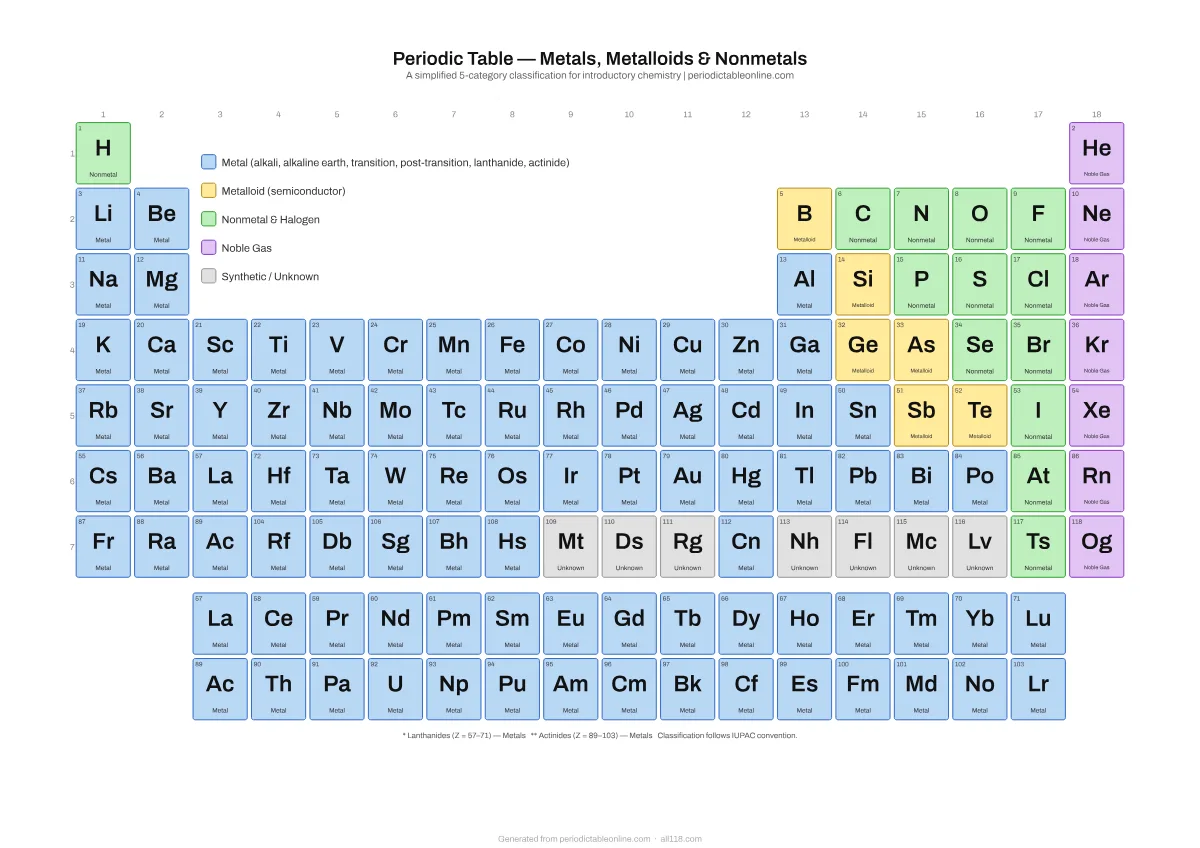
A clean, large-print classification chart ideal for introductory or lower-secondary chemistry. Elements are grouped into five categories with bold, high-contrast colours: metals, metalloids, nonmetals and halogens, noble gases, and synthetic or unknown elements. Great as a classroom display poster.
All printable periodic table PDFs · Interactive periodic table
Advertisement
How to tell metals, nonmetals and metalloids apart
| Property | Metals | Metalloids | Nonmetals |
|---|---|---|---|
| Appearance | Shiny (lustrous) | Often shiny | Dull; many are gases |
| State at room temperature | Solid (except mercury) | Solid | Gas, solid, or liquid (bromine) |
| Electrical conductivity | Good conductors | Semiconductors | Poor conductors (insulators); graphite is an exception |
| Solid form | Malleable and ductile | Brittle | Brittle |
| Ions formed | Positive ions (cations) | Varies | Negative ions (anions) |
| Oxides | Basic | Amphoteric | Acidic |
The staircase line
The line steps down from between boron and aluminium to between polonium and astatine. Elements to the left of it are metals, and elements to the right are nonmetals. Hydrogen is the exception: it sits above group 1 but is a nonmetal. Metallic character increases going down a group and to the left along a period, which is why the line slopes the way it does.
Which elements are metalloids?
This table counts seven metalloids: boron, silicon, germanium, arsenic, antimony, tellurium and polonium. Chemists don't fully agree on the list: some leave out polonium, which behaves more like a metal, and some add astatine. Silicon and germanium are the best-known, because their semiconducting properties make computer chips possible.
Where the superheavy elements go
Elements beyond about 100 exist only for seconds or less, so their properties are predicted rather than measured. They are placed by their group: for example, flerovium (114) is expected to be a metal, and tennessine (117) sits with the halogens. Our element lists and each element's page mark predicted values clearly.
Frequently asked questions
How many metals are on the periodic table?
About 91 of the 118 elements are metals: the alkali and alkaline earth metals, the transition metals, the post-transition metals, the lanthanides and the actinides. That count includes superheavy elements whose metallic character is predicted.
Which elements are metalloids?
The elements usually classed as metalloids are boron, silicon, germanium, arsenic, antimony and tellurium. This table also includes polonium. Some sources add astatine and leave out polonium.
Where are the nonmetals on the periodic table?
The nonmetals are on the right of the staircase line, plus hydrogen at the top left. They include carbon, nitrogen, oxygen, phosphorus, sulfur, selenium, the halogens (group 17) and the noble gases (group 18).
Is hydrogen a metal or a nonmetal?
Hydrogen is a nonmetal. It sits above group 1 because it has one outer electron, but it is a gas made of H₂ molecules, not a metal. It only becomes metallic under extreme pressure.
What are the properties of metalloids?
Metalloids look metallic but are brittle, and most are semiconductors: they conduct electricity better than nonmetals but worse than metals. Their oxides are often amphoteric, reacting with both acids and bases.