Periodic Table with Molar Mass
The molar mass of all 118 elements in g/mol, with a printable chart and a calculator for compounds.
An element's molar mass is the mass of one mole of its atoms, in grams per mole (g/mol). It has the same number as the element's standard atomic weight: carbon is 12.011, so one mole of carbon atoms has a mass of 12.011 g. The values below are the CIAAW 2024 standard atomic weights, the same figures used in the molar mass calculator and on every element page.
| Atomic number | Symbol | Element | Molar mass (g/mol) |
|---|---|---|---|
| 1 | H | Hydrogen | 1.008 |
| 2 | He | Helium | 4.002602 |
| 3 | Li | Lithium | 6.94 |
| 4 | Be | Beryllium | 9.0121831 |
| 5 | B | Boron | 10.81 |
| 6 | C | Carbon | 12.011 |
| 7 | N | Nitrogen | 14.007 |
| 8 | O | Oxygen | 15.999 |
| 9 | F | Fluorine | 18.998403162 |
| 10 | Ne | Neon | 20.1797 |
| 11 | Na | Sodium | 22.98976928 |
| 12 | Mg | Magnesium | 24.305 |
| 13 | Al | Aluminum | 26.9815384 |
| 14 | Si | Silicon | 28.085 |
| 15 | P | Phosphorus | 30.973761998 |
| 16 | S | Sulfur | 32.06 |
| 17 | Cl | Chlorine | 35.45 |
| 18 | Ar | Argon | 39.95 |
| 19 | K | Potassium | 39.0983 |
| 20 | Ca | Calcium | 40.078 |
| 21 | Sc | Scandium | 44.955907 |
| 22 | Ti | Titanium | 47.867 |
| 23 | V | Vanadium | 50.9415 |
| 24 | Cr | Chromium | 51.9961 |
| 25 | Mn | Manganese | 54.938 |
| 26 | Fe | Iron | 55.845 |
| 27 | Co | Cobalt | 58.933 |
| 28 | Ni | Nickel | 58.693 |
| 29 | Cu | Copper | 63.546 |
| 30 | Zn | Zinc | 65.38 |
| 31 | Ga | Gallium | 69.723 |
| 32 | Ge | Germanium | 72.63 |
| 33 | As | Arsenic | 74.9216 |
| 34 | Se | Selenium | 78.971 |
| 35 | Br | Bromine | 79.904 |
| 36 | Kr | Krypton | 83.798 |
| 37 | Rb | Rubidium | 85.4678 |
| 38 | Sr | Strontium | 87.62 |
| 39 | Y | Yttrium | 88.90584 |
| 40 | Zr | Zirconium | 91.222 |
| 41 | Nb | Niobium | 92.90637 |
| 42 | Mo | Molybdenum | 95.95 |
| 43 | Tc | Technetium | [97] |
| 44 | Ru | Ruthenium | 101.07 |
| 45 | Rh | Rhodium | 102.9055 |
| 46 | Pd | Palladium | 106.42 |
| 47 | Ag | Silver | 107.8682 |
| 48 | Cd | Cadmium | 112.414 |
| 49 | In | Indium | 114.818 |
| 50 | Sn | Tin | 118.71 |
| 51 | Sb | Antimony | 121.76 |
| 52 | Te | Tellurium | 127.6 |
| 53 | I | Iodine | 126.90447 |
| 54 | Xe | Xenon | 131.293 |
| 55 | Cs | Cesium | 132.90545196 |
| 56 | Ba | Barium | 137.327 |
| 57 | La | Lanthanum | 138.90547 |
| 58 | Ce | Cerium | 140.116 |
| 59 | Pr | Praseodymium | 140.90766 |
| 60 | Nd | Neodymium | 144.242 |
| 61 | Pm | Promethium | [145] |
| 62 | Sm | Samarium | 150.36 |
| 63 | Eu | Europium | 151.96 |
| 64 | Gd | Gadolinium | 157.249 |
| 65 | Tb | Terbium | 158.93 |
| 66 | Dy | Dysprosium | 162.5 |
| 67 | Ho | Holmium | 164.93 |
| 68 | Er | Erbium | 167.26 |
| 69 | Tm | Thulium | 168.93 |
| 70 | Yb | Ytterbium | 173.05 |
| 71 | Lu | Lutetium | 174.96669 |
| 72 | Hf | Hafnium | 178.49 |
| 73 | Ta | Tantalum | 180.95 |
| 74 | W | Tungsten | 183.84 |
| 75 | Re | Rhenium | 186.21 |
| 76 | Os | Osmium | 190.23 |
| 77 | Ir | Iridium | 192.22 |
| 78 | Pt | Platinum | 195.08 |
| 79 | Au | Gold | 196.97 |
| 80 | Hg | Mercury | 200.59 |
| 81 | Tl | Thallium | 204.38 |
| 82 | Pb | Lead | 207.2 |
| 83 | Bi | Bismuth | 208.98 |
| 84 | Po | Polonium | [209] |
| 85 | At | Astatine | [210] |
| 86 | Rn | Radon | [222] |
| 87 | Fr | Francium | [223] |
| 88 | Ra | Radium | [226] |
| 89 | Ac | Actinium | [227] |
| 90 | Th | Thorium | 232.04 |
| 91 | Pa | Protactinium | 231.04 |
| 92 | U | Uranium | 238.03 |
| 93 | Np | Neptunium | [237] |
| 94 | Pu | Plutonium | [244] |
| 95 | Am | Americium | [243] |
| 96 | Cm | Curium | [247] |
| 97 | Bk | Berkelium | [247] |
| 98 | Cf | Californium | [251] |
| 99 | Es | Einsteinium | [252] |
| 100 | Fm | Fermium | [257] |
| 101 | Md | Mendelevium | [258] |
| 102 | No | Nobelium | [259] |
| 103 | Lr | Lawrencium | [262] |
| 104 | Rf | Rutherfordium | [267] |
| 105 | Db | Dubnium | [270] |
| 106 | Sg | Seaborgium | [269] |
| 107 | Bh | Bohrium | [270] |
| 108 | Hs | Hassium | [270] |
| 109 | Mt | Meitnerium | [278] |
| 110 | Ds | Darmstadtium | [281] |
| 111 | Rg | Roentgenium | [281] |
| 112 | Cn | Copernicium | [285] |
| 113 | Nh | Nihonium | [286] |
| 114 | Fl | Flerovium | [289] |
| 115 | Mc | Moscovium | [289] |
| 116 | Lv | Livermorium | [293] |
| 117 | Ts | Tennessine | [293] |
| 118 | Og | Oganesson | [294] |
Standard atomic weights, CIAAW 2024 (abridged). A value in [brackets] is the mass number of the longest-lived isotope, for elements with no stable isotopes. Molar mass in g/mol has the same number as atomic weight.
Print this chart
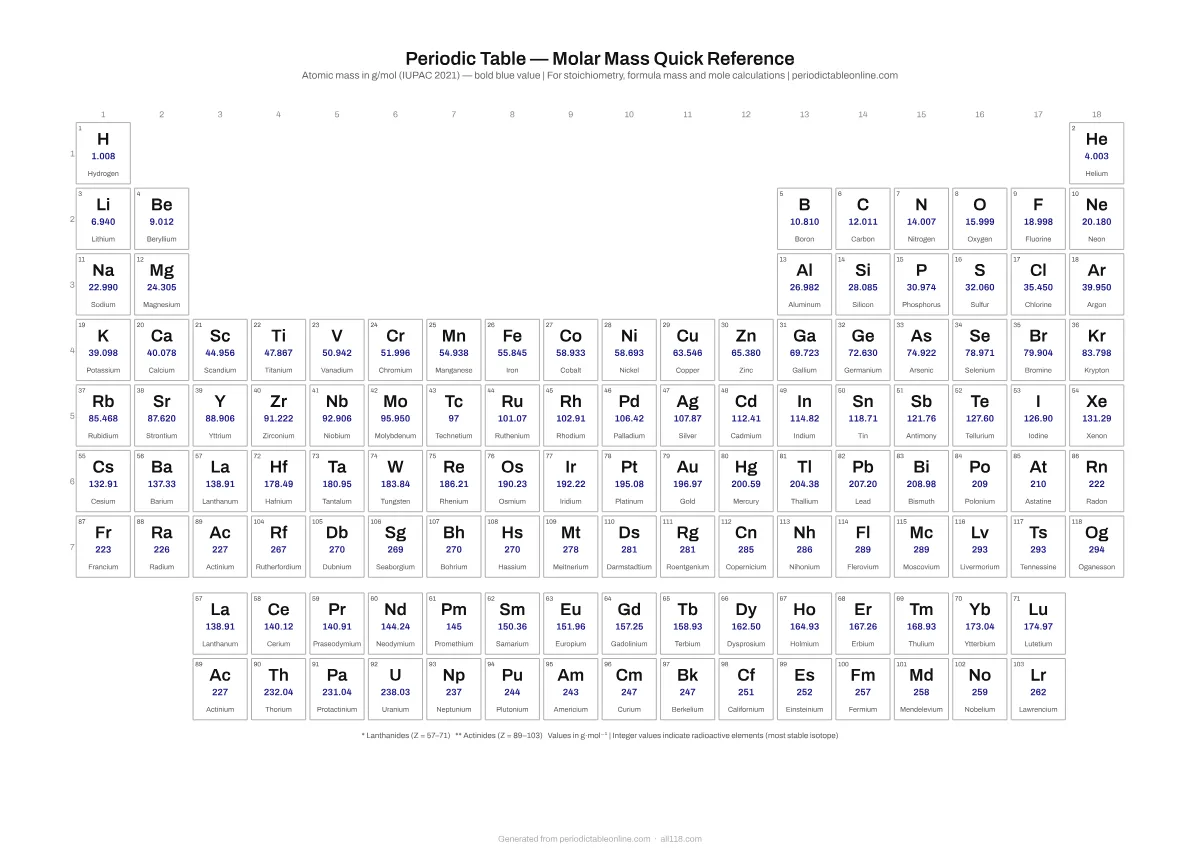
A clean black-and-white table with each element's atomic mass displayed in large, bold blue text — making it fast to scan and read even under pressure. Atomic masses follow IUPAC 2021 values with 2–3 decimal places for main group elements and integers where no standard atomic weight exists. Perfect for mole calculations, formula mass work, and titration problems.
All printable periodic table PDFs · Interactive periodic table
Advertisement
How to find the molar mass of a compound
Add up the molar masses of all the atoms in the formula. For water, H₂O: 2 × 1.008 (hydrogen) + 16.00 (oxygen) = 18.02 g/mol. For sodium chloride, NaCl: 22.99 + 35.45 = 58.44 g/mol. For brackets, multiply everything inside: Ca(OH)₂ has one calcium, two oxygens and two hydrogens. The molar mass calculator does this for any formula and shows the working.
Why most molar masses aren't whole numbers
Most elements are a mixture of isotopes with different masses. The standard atomic weight is the average over the isotopes found in nature, weighted by how common each one is. Chlorine is about three-quarters chlorine-35 and one-quarter chlorine-37, which is why its molar mass is 35.45 and not 35 or 37. Our guide to calculating average atomic mass shows the sum step by step.
What the brackets mean
Elements with no stable isotopes have no natural isotope mix, so they have no standard atomic weight. For them the table gives the mass number of the longest-lived isotope in [brackets]: technetium is [97] and plutonium is [244]. Use that number when a question asks for the molar mass of a radioactive element.
How many decimal places to use
School and exam questions usually use one or two decimal places (C = 12.0, Cl = 35.5). The values here are given to the precision CIAAW publishes, so you can round them to whatever your course asks for.
Frequently asked questions
What is molar mass?
Molar mass is the mass of one mole of a substance, in grams per mole (g/mol). For an element it has the same number as the standard atomic weight, so the molar mass of oxygen is 15.999 g/mol.
Is molar mass the same as atomic mass?
They have the same number but different units. Atomic weight is a ratio with no unit (or atomic mass units for one atom). Molar mass is that number in grams per mole.
How do you calculate the molar mass of a compound?
Multiply the molar mass of each element by the number of its atoms in the formula and add them up. For CO₂: 12.011 + 2 × 15.999 = 44.009 g/mol.
What is the molar mass of water?
The molar mass of water (H₂O) is 18.015 g/mol: 2 × 1.008 for hydrogen plus 15.999 for oxygen.
Why is chlorine's molar mass 35.45?
Natural chlorine is a mix of about 76% chlorine-35 and 24% chlorine-37. The weighted average of their masses is 35.45 g/mol.